

Here you can find out what you need to bear in mind when creating a certified translation for lingoking.
Stylistic guidelines
for certified translations
- Connecting sheets: There are several permitted variants. We at lingoking use the variant that is also recognised standardly abroad by the authorities.
- If a translation consists of several pages, they must be numbered.
- A copy of the source text must be attached to the translation.
- In the case of a few pages, the upper left corners of the sheets should be folded over in a scaled manner and stapled. In addition, the translator's stamp should be printed on the reverse of the folded-over sheets. This serves as a security measure against forgery, as it prevents the binding from being separated and individual pages from being removed.
- If there are multiple sheets, it is recommended to use eyelets and basting cotton, for example.
- The stamp and signature should be in blue (so that these elements stand out from the rest of the text and the translations are forgery-proof).
- Please use high-quality paper and ensure good print quality.
- Logos/signatures/coats of arms/stamps/seals or similar must NOT be copied into the translation, but must be indicated as a note in square brackets; any text contained therein must be translated.
What a certified translation should contain
- [Header of translation] – The header of the certified translation must include „Page 1 of 1 of certified translation from XXX“
- [Regarding the entire translation] –
- All translator's notes must be provided in square brackets.
- Stamps and other symbols must always be indicated and, if necessary, translated.
- Institutions and public authorities must always be indicated with an explanation in square brackets.
- All points of the source text must be fully translated or indicated.
- The translation should be done according to the layout of the source text.
- [Footer] – Certification note: a generally valid certification note with an indication of the form of the source text, name, place, and date of the translation.
- If the translator’s address is not provided on the stamp, it must also be included in the certification note.
- [Certification of translation] – The certification stamp must be placed on the front side next to the certification note. The stamp must also be accompanied by a signature. This applies to all pages of the translation.
- [Back page, single-staple top left corner binding/Schuppenheftung] - The translation must be attached to either the simple or certified copy of the original. The documents must be staggered and then stamped and signed at the point of attachment. Optionally, the source text can also be stamped, but this is not mandatory for the validity of the certified translation.
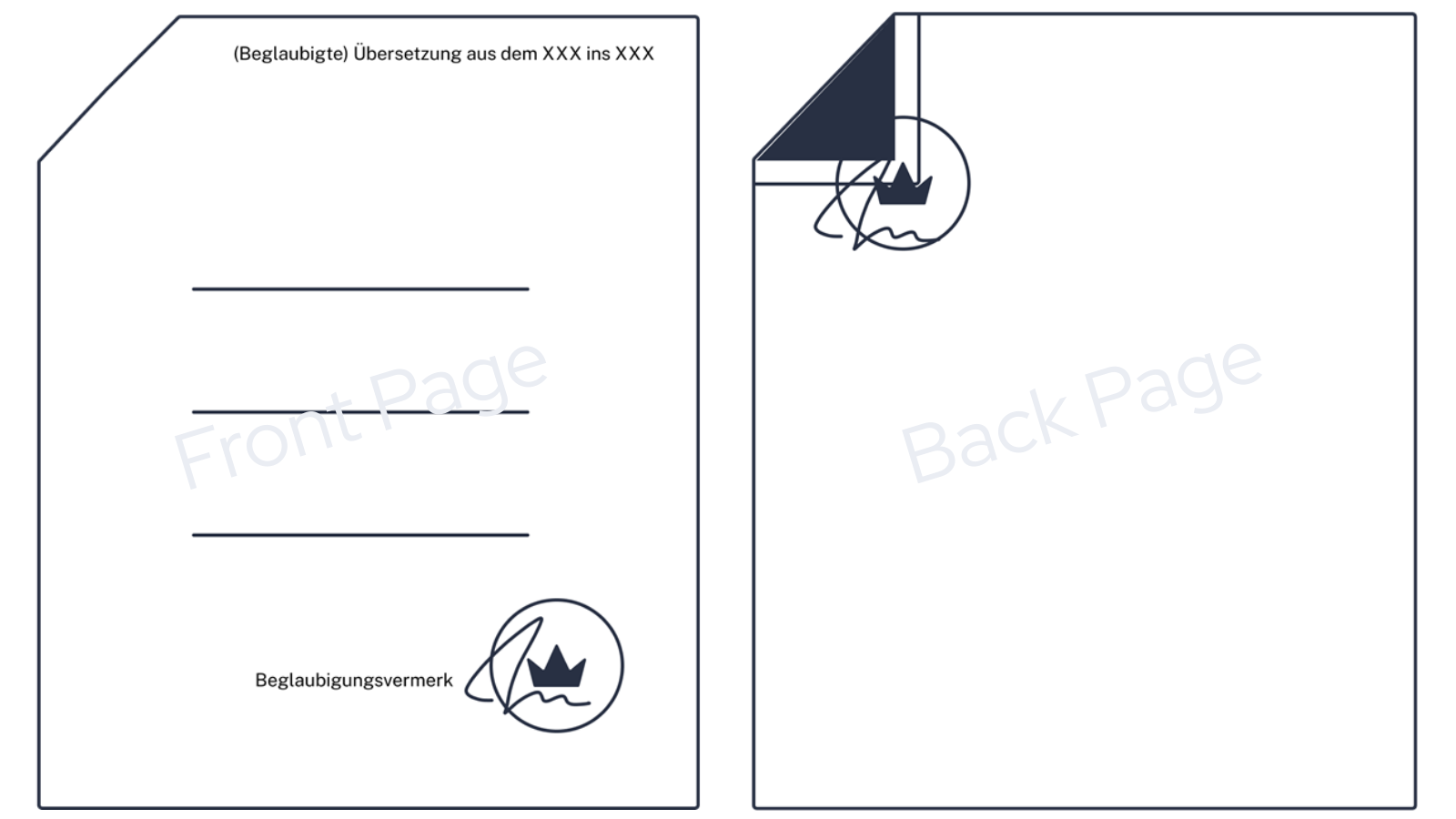
The header of the certified translation must include „Page 1 of 1 of certified translation from XXX“.
- All translator's notes must be provided in square brackets.
- Stamps and other symbols must always be indicated and, if necessary, translated.
- Institutions and public authorities must always be indicated with an explanation in square brackets.
- All points of the source text must be fully translated or indicated.
- The translation should be done according to the layout of the source text.
- Certification note: a generally valid certification note with an indication of the form of the source text, name, place, and date of the translation.
- If the translator’s address is not provided on the stamp, it must also be included in the certification note.
- The certification stamp must be placed on the front side next to the certification note. The stamp must also be accompanied by a signature. This applies to all pages of the translation.
The translation must be attached to either the simple or certified copy of the original. The documents must be staggered and then stamped and signed at the point of attachment. Optionally, the source text can also be stamped, but this is not mandatory for the validity of the certified translation.
Additional options for translations – how it works
How to make the correct scan
You prepare the certified translation as described above, including stapling and stamping, as if it were to be sent by post. Then scan all pages, including all reverse sides, in the following order: first the target text (your translation), then the source text, and then the reverse side with the signed and stamped reverse side fanned out. The scan should be a single document (PDF). Done!
How to make additional copies
Additional copies of a certified translation are prepared in the same way as any other certified translation, i.e. including certification note, stamp, signature, etc. All copies are equivalent originals.
Do you have any questions?
Please get in touch as soon as a question occurs to you. You can contact us directly by email: vendormanagement@lingoking.com